Supervised fine-tuning
Learn task-appropriate follow-up directions from human-reviewed intents and validated teacher-generated slates.
39.5K training slates1Qwen Business Unit of Alibaba 2Southeast University 3ShanghaiTech University
† Project lead ✉ Co-corresponding authors
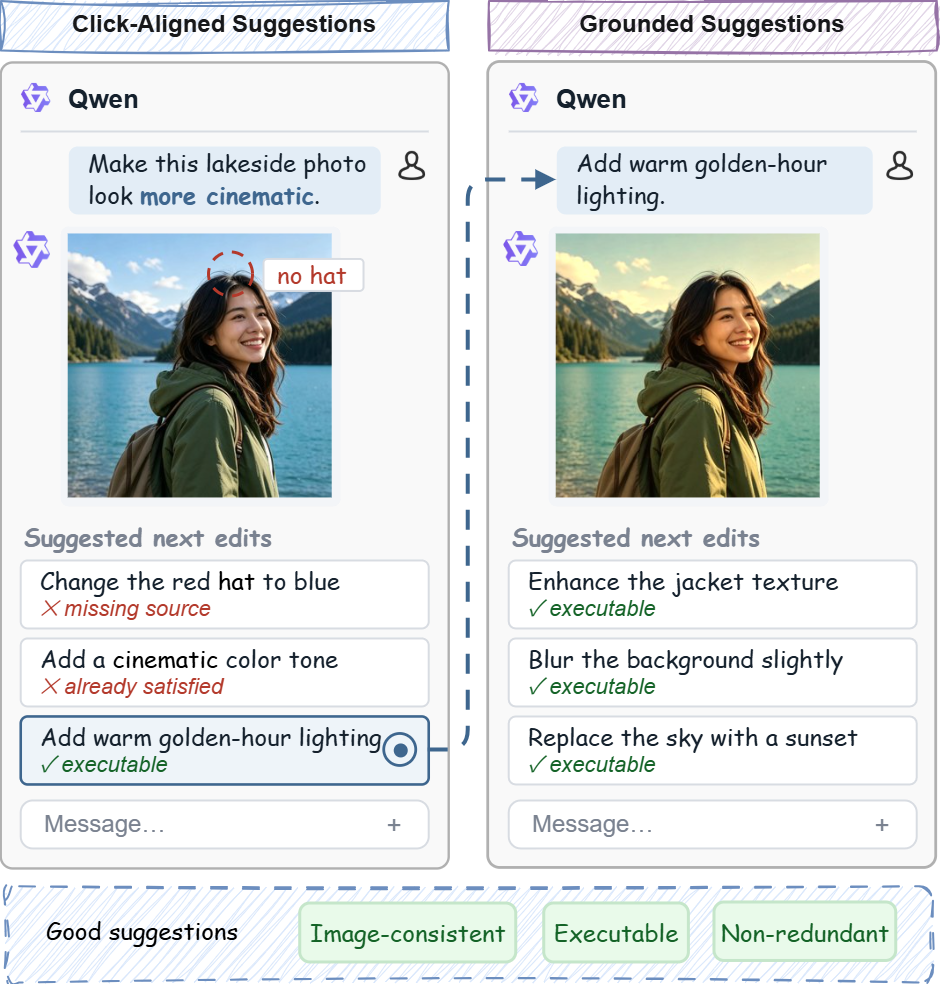
Conversational assistants increasingly recommend follow-up edits to help users continue a task. Existing systems primarily target text-only interactions, leaving image-creation conversations underexplored. In image-creation tasks, useful follow-up edit suggestions must reflect user preferences, offer diverse directions, and remain executable on the current image.
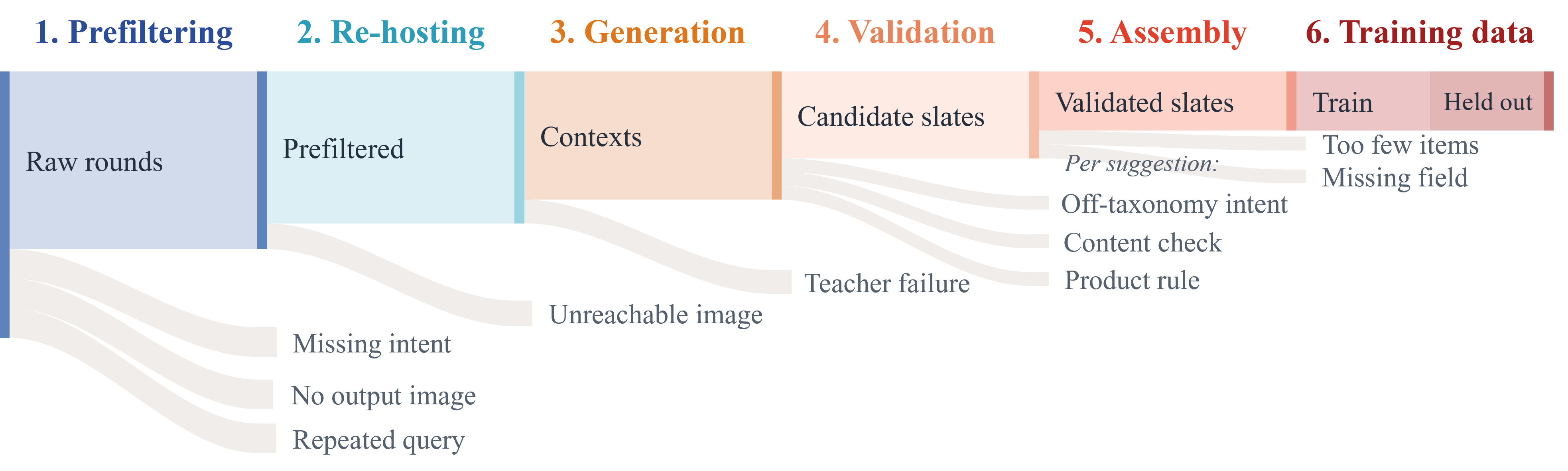
We collected 100,000 real multi-turn image-creation conversation samples from Qwen App and found that 80.1% are image-dependent, underscoring the need for multimodal recommendation. We address this setting with a three-stage framework. Stage 1 constructs SFT targets from real online data and a human-reviewed table of appropriate follow-up editing intents. Stage 2 uses user click feedback and multi-objective reinforcement learning to align the policy with actual user choices. Stage 3 introduces a visual verifier as additional training supervision to reduce inconsistencies between suggested edits and the current image.
Extensive automatic and human evaluations show that the framework significantly outperforms baselines. In a live user-randomized A/B test with millions of users, the final framework reduces visual inconsistency from 3.7% to 0.9% and improves recommendation CTR by 32.70%, image take-away rate by 16.32%, and average conversation turns per user by 39.90% (all p<0.05).
Motivation
Text-only relevance is not enough after an image has changed. Each recommended edit must be grounded in the latest visual state.
Our method
Each stage introduces a new source of supervision and addresses a failure left by the previous stage.
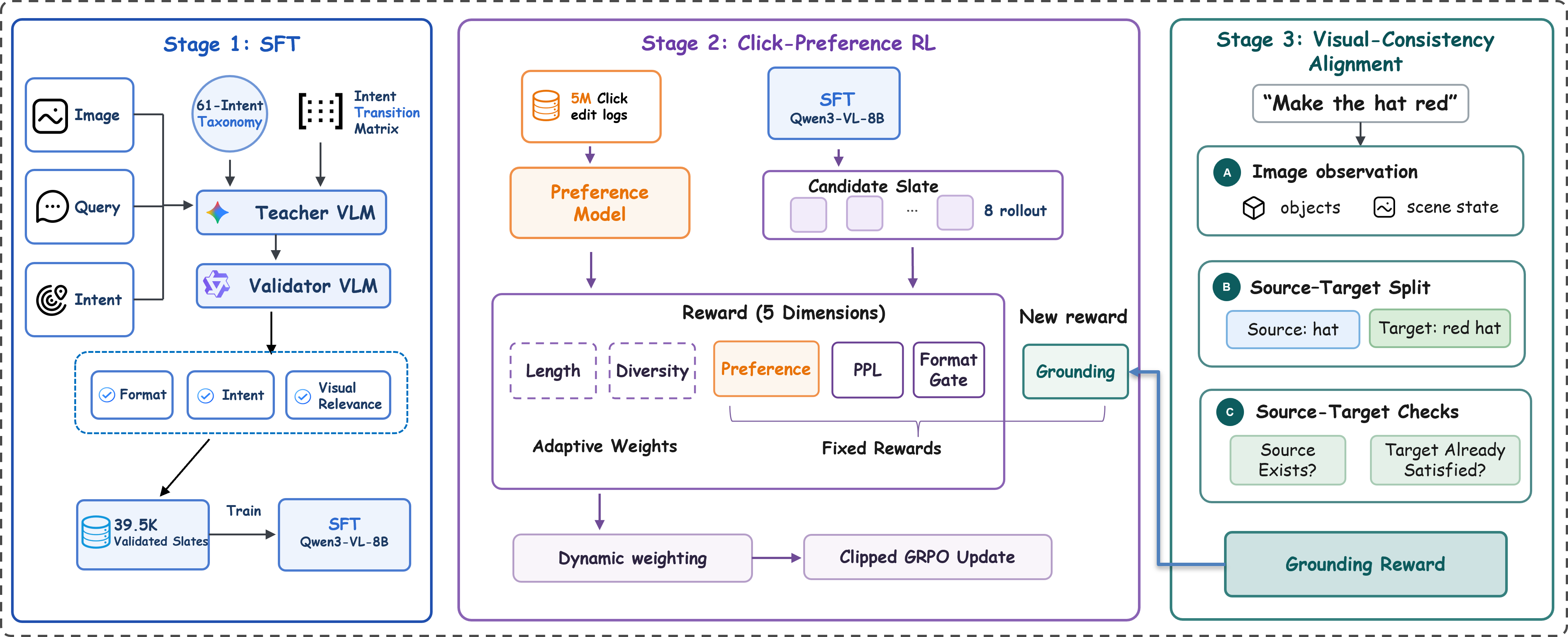
Learn task-appropriate follow-up directions from human-reviewed intents and validated teacher-generated slates.
39.5K training slatesLearn actual user preference from click pairs while protecting format, proximity, length, and diversity.
173,071 preference pairsAdd image-first source–target verification as a sixth reward and explicitly train away inconsistent edits.
training-time supervision onlyStage 1 · Task supervision
Online inputs provide the context, people define appropriate next directions, and a teacher turns those directions into candidate text.
Stage 2 · Behavioral supervision
Click signals reveal which follow-up users want to continue with. We turn this behavioral feedback into pairwise preferences and learn a reward model before policy optimization.
For the same recommendation context, a selected follow-up is contrasted with an unselected alternative.
Replace the sky with a sunset
Enhance the jacket texture
The reward model learns which suggestion better matches user interest from real recommendation choices.
Stage 2 jointly optimizes five non-grounding signals. Stage 3 retains them and adds visual consistency as the sixth reward.
Stage 2 raises expert-rated quality and online CTR, but click feedback captures what looks appealing—not whether the edit is supported by the current image.
Stage 3 · Visual supervision
The verifier inventories the image before reading any candidate, preventing the instruction itself from creating unsupported visual assumptions.
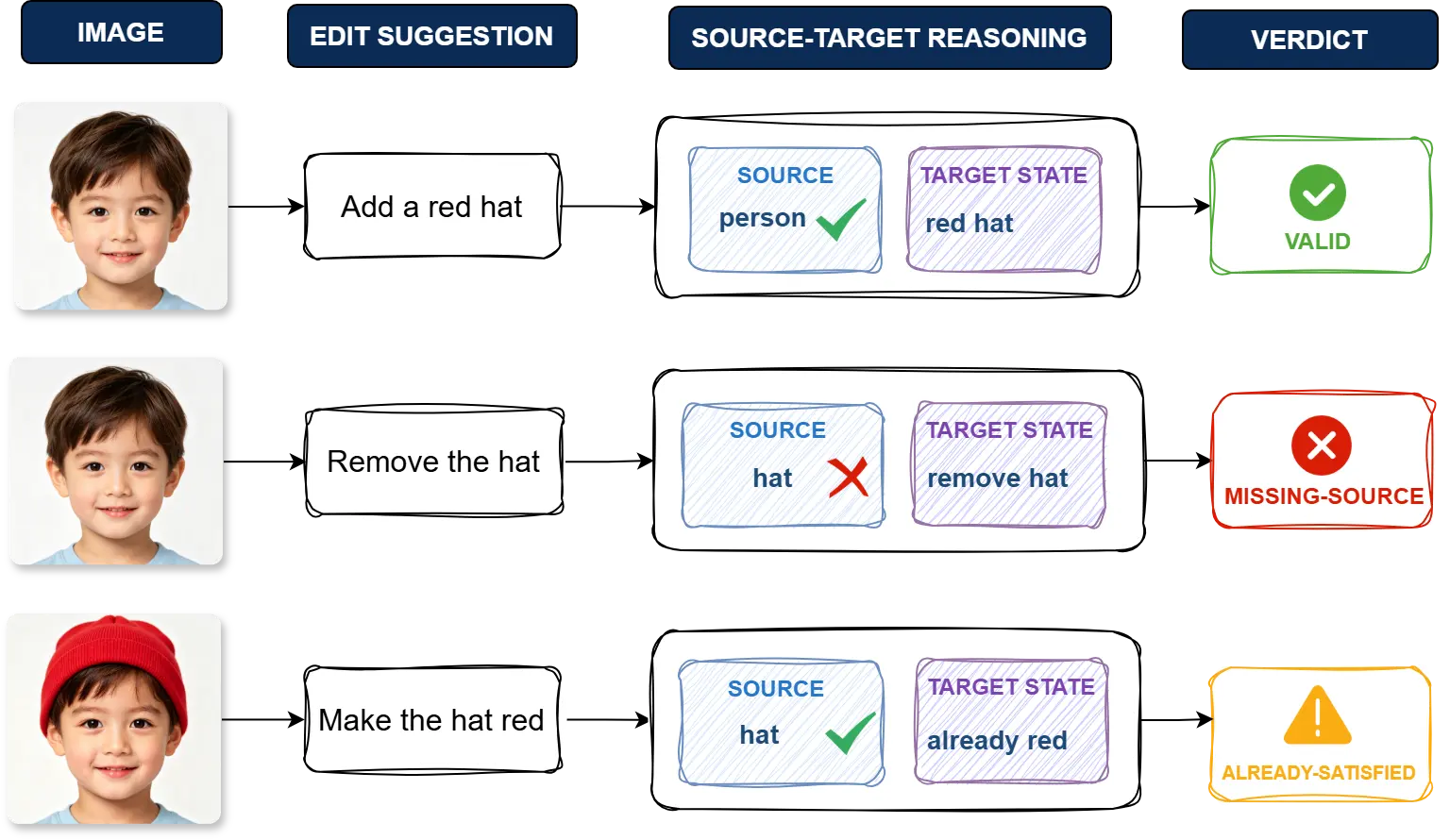
Record visible people, objects, text, regions, and scene state before candidates are shown.
Extract the operation, required sources, and desired target state from each suggestion.
Ground every source with visual evidence and compare desired and current target states.
Penalize missing sources and already-satisfied targets during GRPO; serve only the final 8B policy.
End-to-end evaluation
Policies are evaluated on the same held-out Qwen App sessions with identical decoding. The online study uses concurrent user-level randomization and equal traffic allocation.
| Policy | GSB ↑ | Visual inconsistency ↓ | Redundancy ↓ |
|---|---|---|---|
| Prompt-engineered policy (PE) | +0 | 8.6% | 23.3% |
| Stage 1 · SFT | +332 | 3.0% | 17.2% |
| Stage 2 · SFT + click RL | +405 | 3.7% | 11.9% |
| Stage 3 · Full framework OURS | +446 | 0.9% | 8.8% |
GSB is aggregate expert-score gain over PE. Grounding is measured by an external visual audit.
More users select a recommended next edit.
More users keep the resulting edited image.
Grounded suggestions sustain longer creative sessions.
14 days · millions of users · 5% traffic per arm · all reported lifts p<0.05
A one-pass VLM confuses sources with targets and rejects valid creative edits. The ordered image-first procedure improves recall while sharply reducing false rejection.
| Verifier | Missing-source recall ↑ | Already-satisfied recall ↑ | Union recall ↑ | False rejection ↓ |
|---|---|---|---|---|
| Single-pass VLM | 61.6% | 43.4% | 47.5% | 22.2% |
| Source–target verifier OURS | 92.9% | 74.5% | 78.7% | 0.6% |
Takeaway
Behavioral feedback teaches the model what users want to choose. Visual supervision teaches it which choices remain meaningful on the current image.
Combining human-reviewed task structure, real click preference, and image-first verification produces follow-up edits that are more attractive, more diverse, and substantially more consistent—improving both the immediate recommendation and the creative conversation that follows.
@article{zhang2026edit,
  title={What to Edit Next: Visually Aligned Image-Editing Follow-Up Suggestions in Conversational Systems},
  author={Zhang, Zhijing and Yu, Jinpeng and Song, Xin and Li, Bingnan and Li, Chuyue and Du, Changhui and Fang, Xiaolin and Liu, Jiaming and Huang, Ruihua},
  journal={arXiv preprint arXiv:2608.07565},
  year={2026}
}